The History of Padel
From a private court in Acapulco to a global club sport, this is how padel found its shape and spread.
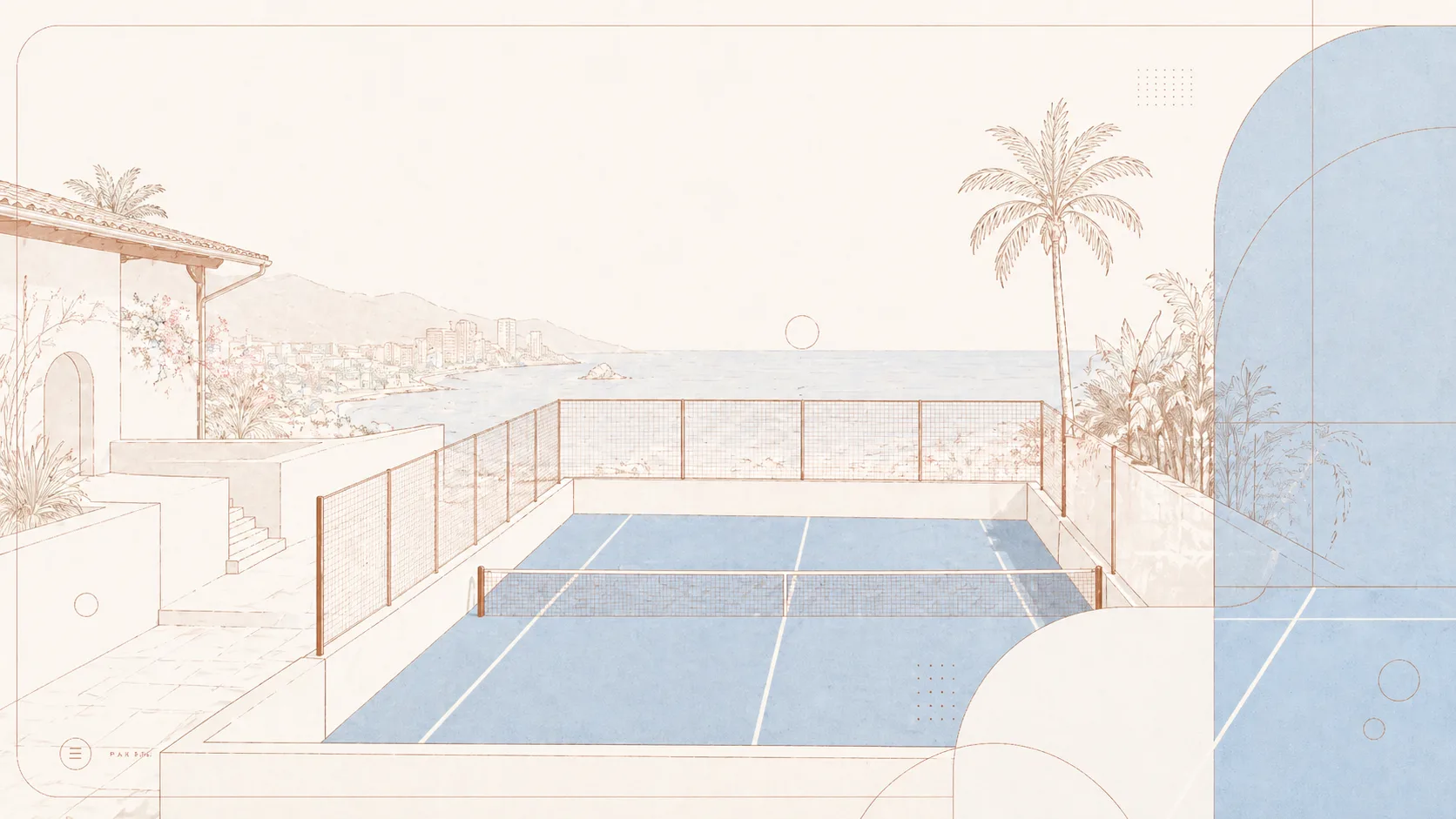
Padel began as a practical answer to a spatial problem.
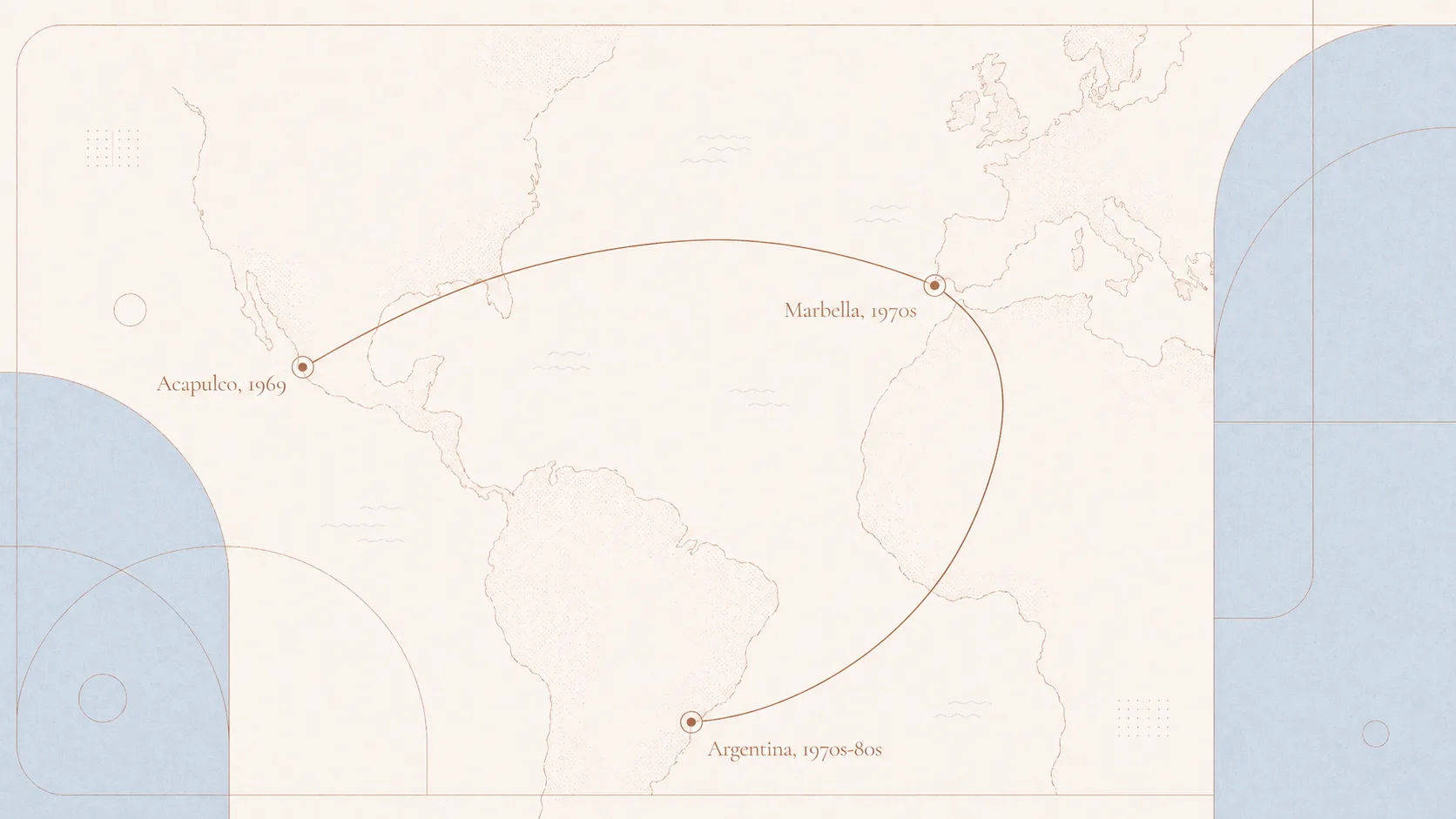
In 1969, Mexican businessman Enrique Corcuera wanted a place to play at his home in Las Brisas, Acapulco. The space was too small for a full tennis court, so he worked with what he had: a 20-by-10-metre court, a net across the middle, and walls around the playing area. The walls were not decoration. They kept the ball in play and changed the rhythm of the game.
That single decision gave padel its identity. Tennis gives you open space. Squash gives you walls. Padel sits between them, borrowing the rally structure of a racket sport and the rebound logic of an enclosed court.
Corcuera's wife, Viviana, helped give the game its first written shape. According to the International Padel Federation, she drafted an early set of rules and gave them to him as a birthday gift. What began as a domestic invention was already becoming something repeatable: a court size, a way to score, a shared understanding of how the wall could be part of the point.
From Acapulco to Marbella
The sport might have stayed a private curiosity if it had not travelled through friendship.
Prince Alfonso of Hohenlohe, founder of the Marbella Club Hotel, visited Corcuera in Mexico and played the game at his home. He understood quickly that it had the qualities resorts and clubs look for: it was social, compact, easier to start than tennis, and still technical enough to reward serious players.
In the early 1970s, Hohenlohe brought padel to Spain and built courts at the Marbella Club in Andalusia. That move changed the scale of the game. In Marbella, padel was no longer only a backyard solution. It became a club experience, played by guests, friends, and eventually a wider social circle along the Costa del Sol.
The timing mattered. Marbella in the 1970s was a meeting point for European and Latin American families, athletes, entrepreneurs, and regular travellers. A game that was easy to explain and difficult to stop playing could move quickly in that setting.
Argentina makes it a culture
Around the same period, the sport crossed the Atlantic again.
Julio Menditeguy, an Argentine connected to Hohenlohe's tennis circle in Marbella, brought padel to Argentina. Courts appeared at clubs including Club Tortugas and Mar del Plata Ocean Club, and the game found a country already deeply comfortable with club sport, doubles play, and intense recreational competition.
Argentina did more than adopt padel. It gave the sport a competitive personality.
By the 1980s, Argentina had become one of padel's strongest homes. The Asociacion Padel Argentino was founded in 1988, and that same year Spain and Argentina played one of the first major international competitions in Mar del Plata. The rivalry between the two countries would define much of the sport's elite level for decades.
The Argentine boom also helped clarify what made padel different from a casual resort game. It was quick to learn, but at high level it became tactical and demanding. The wall was not a gimmick. It was a second language.
The court becomes portable
One reason padel spread is that its court has a strong visual identity. You can recognize the sport instantly: glass, mesh, walls, and a tight rectangle that keeps everyone close to the action.
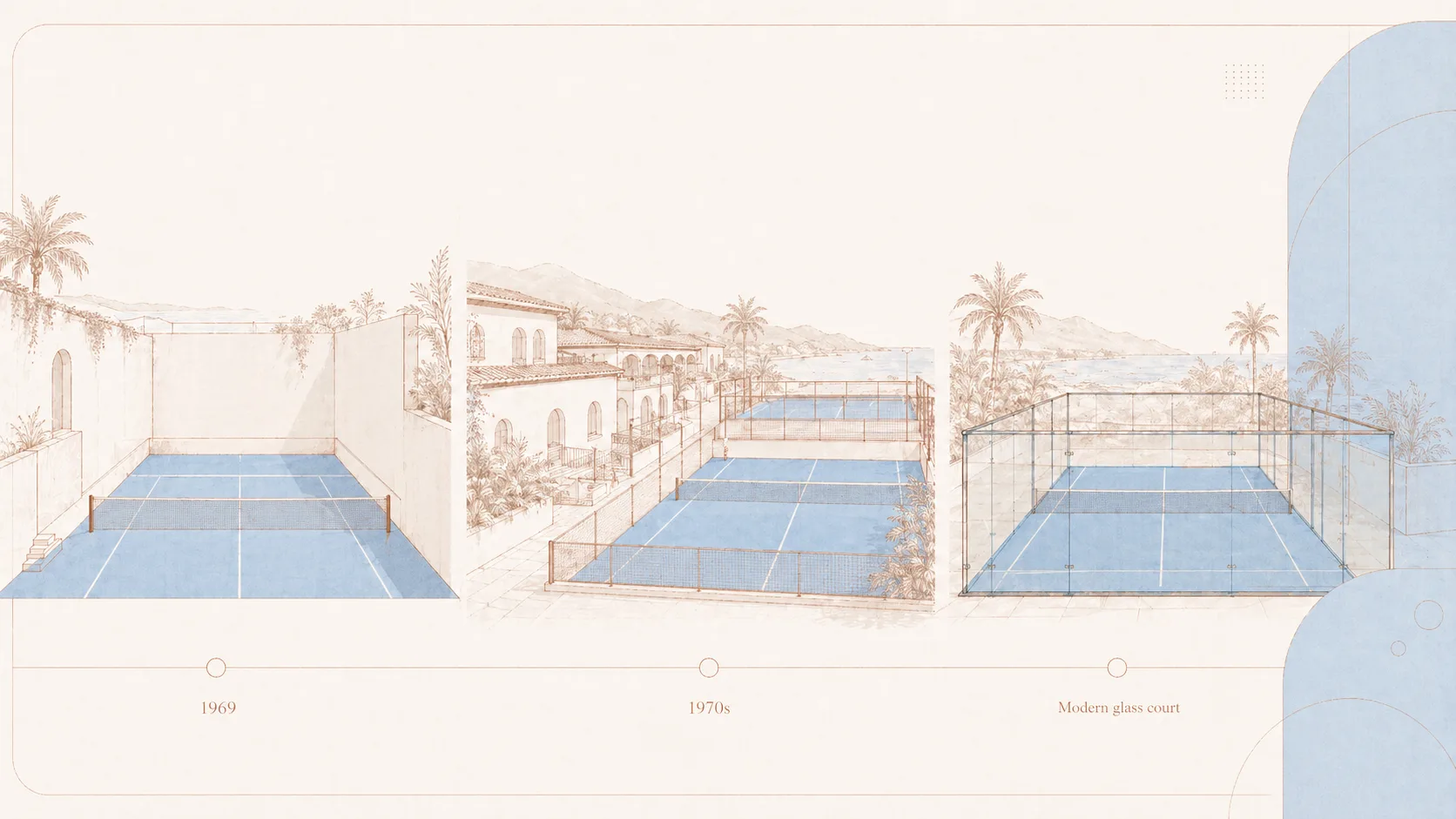
That identity became easier to export in 1989, when coach Jorge Galeotti of Mar del Plata introduced the Crystal Palace, a detachable and transportable glass court. Portable glass courts made padel more visible, more event-friendly, and easier to stage in places where permanent infrastructure was not yet ready.
This was an important step. Sports grow faster when people can see them clearly. A glass court turns a match into a theatre: the audience can read the angles, the walls are transparent, and the court feels like a contained arena rather than a fenced-off facility.
Rules, federations, and a world stage
As padel moved between countries, the sport needed shared rules.
In the early years, naming and regulations were not completely unified. Argentina used "paddle" in some contexts, while Spain used "padel" or "padel tenis". Different clubs and countries could interpret details differently.
That began to change in the 1990s. On 12 July 1991, the International Padel Federation was founded in Madrid by the Argentine, Spanish, and Uruguayan padel associations. The first World Padel Championships followed in 1992, held in Madrid and Seville.
In 1997, Spain and Argentina reached an agreement in Barcelona to unify the rules and standardize the name "Padel". That kind of administrative detail can sound dry, but it matters. A sport cannot become truly international if every country is playing a slightly different version.
By the end of the decade, national federations had formed across Europe and the Americas. Padel now had institutions, rankings, championships, and a clearer path for players who wanted to move from club play to competition.
From club sport to professional spectacle
The 2000s and 2010s gave padel a more professional structure.
The Padel Pro Tour launched in 2005 and ran for eight seasons. In 2013, the World Padel Tour replaced it and helped shape the modern entertainment version of the sport: named pairs, packed arenas, broadcast highlights, and a global audience learning the names of players as much as the rules.
The professional side continued to consolidate in the 2020s. Premier Padel launched in 2022 as the official global professional tour governed by the International Padel Federation and backed by Qatar Sports Investments. By 2024, it had become the main global circuit after the World Padel Tour was integrated into the new structure.
This period also coincided with a wider participation boom. FIP reports that by 2026, padel is played in more than 150 countries, with approximately 35 million amateur players and 100 affiliated federations. The numbers explain the momentum, but not the feeling.
The feeling is simpler: padel is unusually easy to invite someone into.
Why it travelled so well
Padel spread because it solved several problems at once.
For players, it is approachable. The smaller court means beginners touch the ball often. The serve is underhand. Doubles play makes the first session social instead of lonely. The walls extend points and give new players more chances to recover.
For clubs, it is efficient. A padel court uses less land than a tennis court and creates a high-energy match in a compact space. The glass court looks good, photographs well, and lets spectators stand close to the game.
For serious players, it has depth. Positioning, patience, lobs, bandejas, viboras, wall reads, and partnership patterns can take years to master. The sport is generous at the beginning and demanding at the top.
That combination is rare. Many sports are either accessible or deep. Padel is both.
A sport built around return
The story of padel is not only about invention. It is about return.
The ball returns from the wall. Players return for rematches. The sport itself keeps returning to club spaces: Acapulco, Marbella, Buenos Aires, Madrid, Milan, Stockholm, Dubai, and now thousands of local courts where the same pattern repeats.
Someone tries it once. They understand enough to play. They miss enough to want another match. They come back.
That is the real history of padel: a small court in Acapulco became a global sport because the game makes people want to play again.