The Global Padel Report Maps 21 Countries Into Five Archetypes. We Operate in the One It Missed.
Playtomic and Strategy&'s Global Padel Report 2026 sorts 21 countries into five market archetypes. Turkey is not mentioned once. So we placed it on their map ourselves.
On a weeknight in Istanbul, a padel court is easy to explain and hard to book.
The evening slots went days ago. Half the players on court picked up a racket for the first time this year, and you can tell, because they are already arguing about the rematch. At the front desk, someone is asking the question every operator in this city hears nightly: did anything open up?
This summer, the industry published its definitive map of the sport. Playtomic and Strategy&'s Global Padel Report 2026 runs 57 pages. It counts courts, clubs, and players on every continent, and it sorts 21 countries into five market archetypes, from the mature heartlands of Spain and Argentina to the boom-and-bust markets of Sweden and Chile.
Turkey is not mentioned once.
Fifty-seven pages, five archetypes, zero mentions
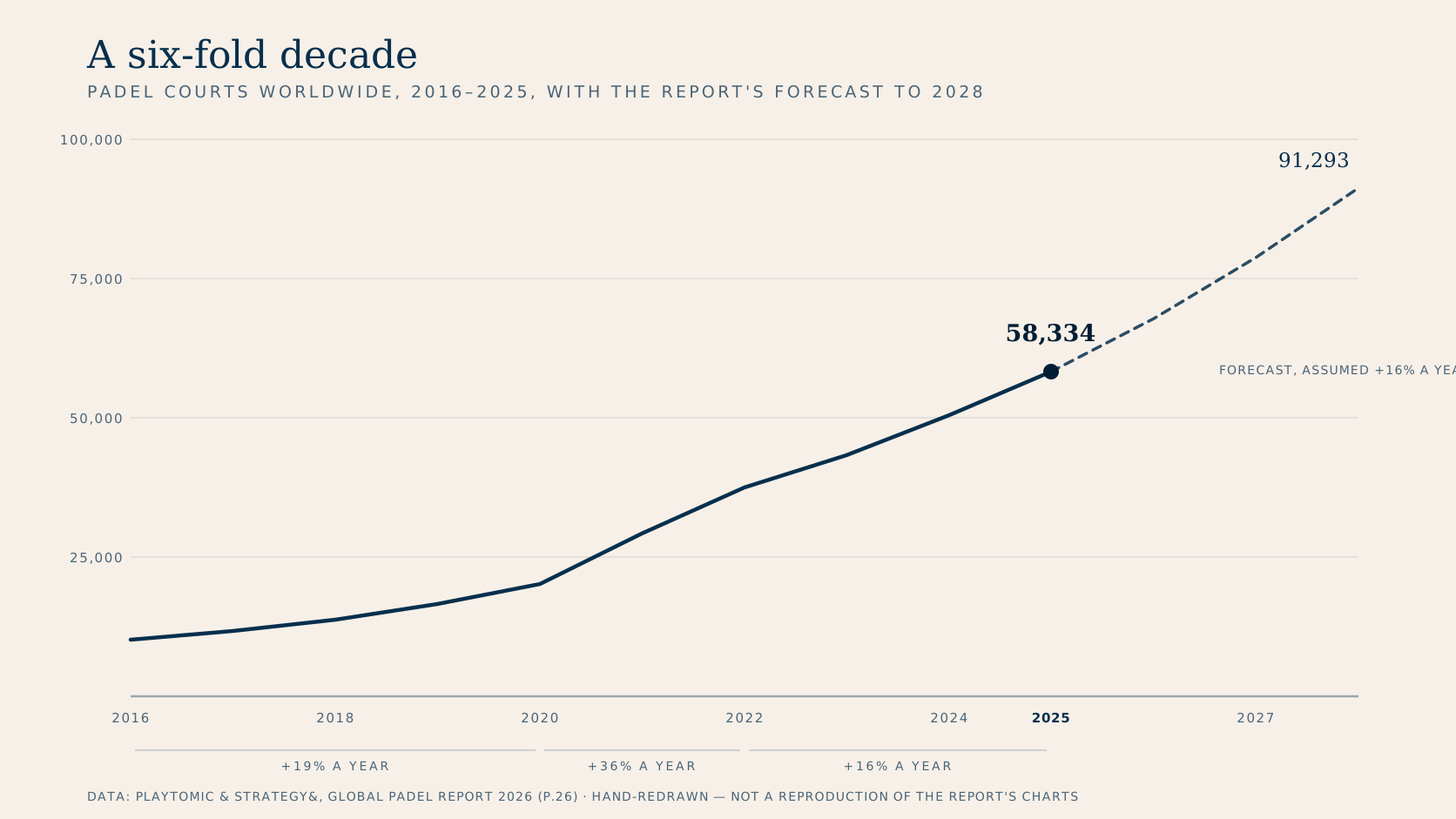
The report deserves to be taken seriously, which is why the omission is interesting. It counts 58,334 courts and 20,902 clubs worldwide, and 19.4 million players by its own conservative bottom-up method; FIP's broader federation survey says more than 35 million. The court count has grown roughly six-fold since 2016, and the report projects 91,293 courts by 2028.
We checked the text, then checked it again, then checked the two previous editions. Across the 2024, 2025, and 2026 reports, the words Turkey, Türkiye, and Istanbul appear exactly zero times. Turkey has never been on this map.
There is no conspiracy in that. The report sees what its instruments see, and it says so itself: the framework deliberately leaves out countries that do not fit cleanly, and its club-level data comes from platforms, court manufacturers, and federation estimates. Playtomic has almost no footprint here; the Turkish scene runs on domestic booking apps and phone calls. FIP's national estimates visibly lag the ground. Turkey is not forgotten. It is unmapped.
If the report's authors reply that Turkey simply is not on their platform, that is not a rebuttal. That is our point. A market can be real and still be invisible to every instrument pointed at it.
The map has five neighborhoods
The report's best idea is that padel markets are not early or late so much as different in kind. It sorts them into five archetypes.
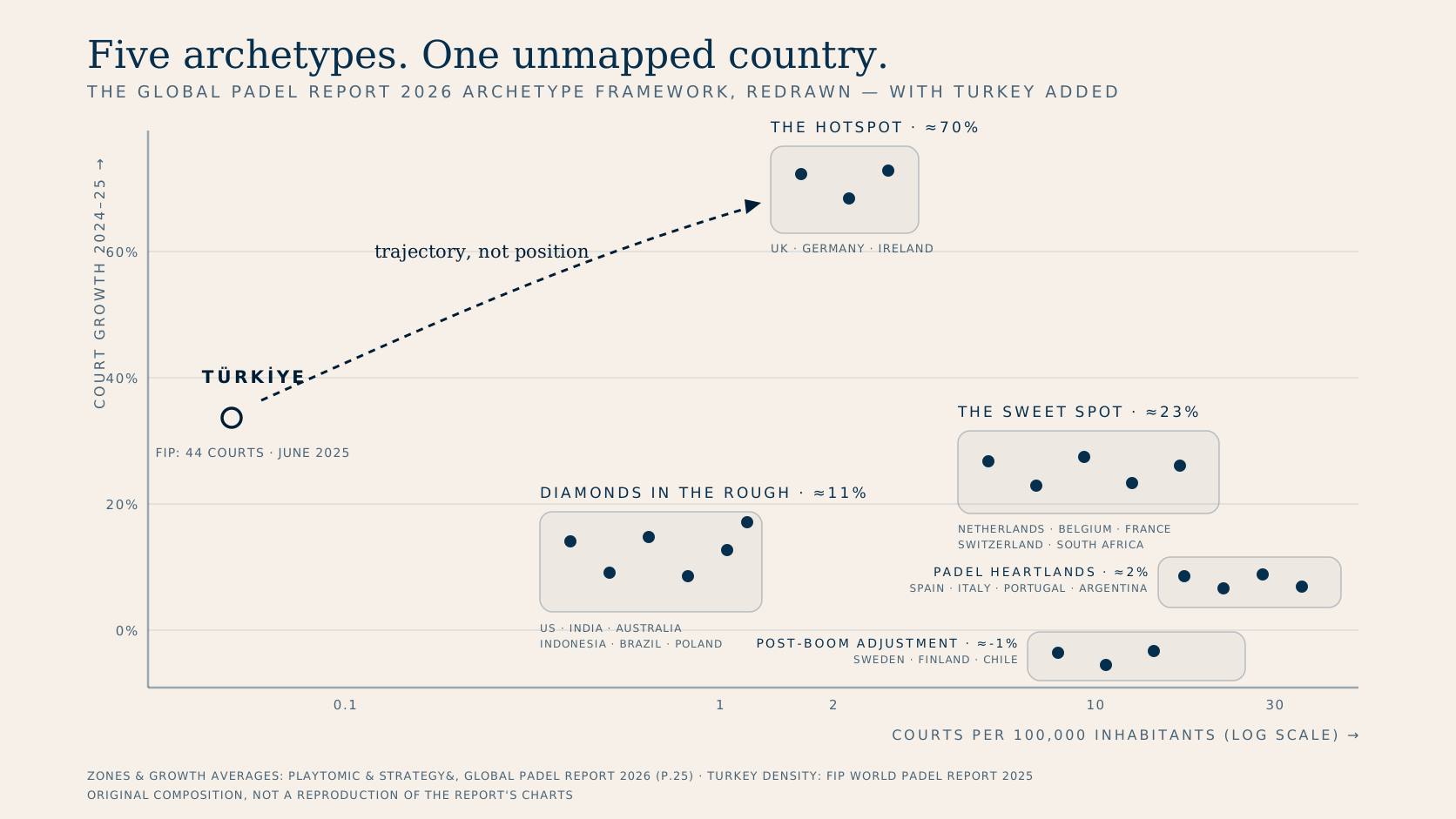
The Padel Heartlands, Spain, Italy, Portugal, and Argentina, are mature and culturally embedded, growing about 2% a year because there is little room left to grow. The Sweet Spot markets, the Netherlands, Belgium, France, Switzerland, and South Africa, add supply in step with demand at around 23%. Diamonds in the Rough, including the US, India, Australia, Indonesia, Brazil, and Poland, are early and fragmented at about 11%. The Post-Boom markets, Sweden, Finland, and Chile, built ahead of demand and are now shrinking through a correction.
And then there is the Hotspot, the archetype the report calls the acceleration engine of global padel: the UK, Germany, and Ireland. Roughly two courts per 100,000 inhabitants. Four hundred to six hundred players per 100,000. Around 70% growth. Mid-premium and premium positioning, demand concentrated in core cities, and chains replicating proven formats as fast as they can find sites.
Hold that profile in your head for a moment.
Reading our own market in someone else's chapter
The report says UK clubs run at about 85% peak-hour occupancy, and that roughly half of British players report difficulty finding a peak-time court. It describes Germany's growth as indoor-heavy and conversion-led, with capital-backed operators building large venues because regulation and weather push the sport inside.
Read those pages from Istanbul and the sensation is strange. It is like finding an accurate description of your own street in a guidebook to a different country. Peak-hour scarcity, premium urban positioning, indoor-first builds, demand concentrated in one enormous core city: that is our weeknight.
The public traces are starting to show it. Local court directories now list 19 padel facilities across Istanbul's European and Anatolian sides, with hourly rates running from around 1,000 TL at municipal courts to 3,000 TL at premium clubs. A directory is not a census, and we cite it as texture rather than statistics. But the texture is unambiguous: courts on both continents of one city, a full price ladder, and evenings that sell out first.
The report profiles a market like this. It just never names one like ours.
The honest ledger: where Turkey actually stands
Now the part an operator has to say out loud, before anyone else says it for us.
The only citable national figure comes from FIP's World Padel Report 2025, dated June 2025: 24 clubs and 44 courts in Turkey, which works out to one court per 1,950,000 inhabitants. That is not Hotspot density. It is not even Diamonds in the Rough density. On the report's horizontal axis, Turkey sits almost off the left edge of the chart.
So the claim is precise, and it is not that Turkey is a Hotspot today. The claim is that Turkey fits the Hotspot's qualitative profile and its trajectory, not yet its numbers. That is what emerging means.
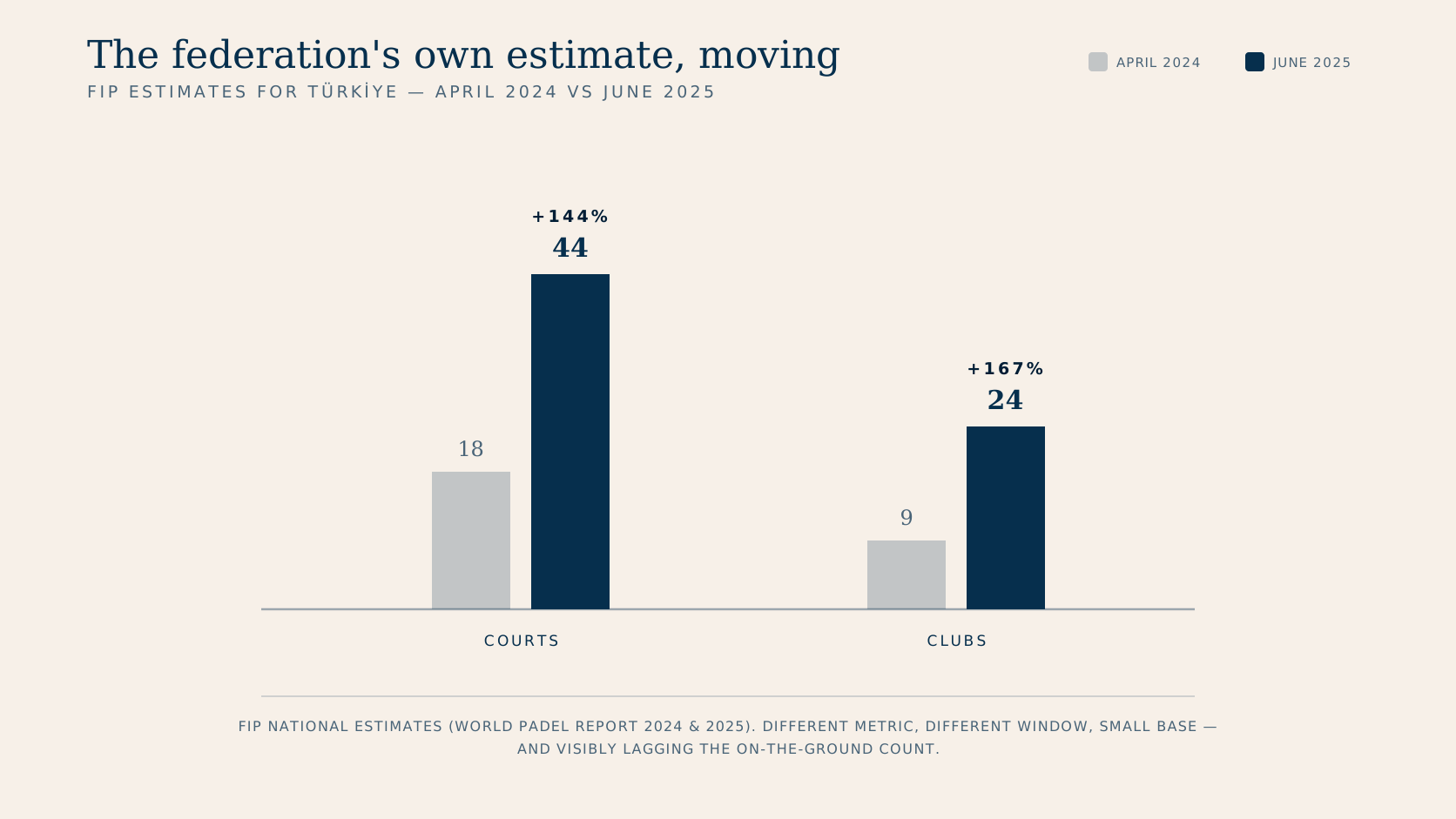
The trajectory is the interesting part. FIP's previous estimate, from April 2024, put Turkey at 9 clubs and 18 courts. Fourteen months later its own count read 24 and 44: the federation's estimate of the market more than doubled between two editions of its own report, and the estimate visibly trails what is actually opening. These are small numbers on a small base, measured differently and over a different window than the report's archetype averages. We are not comparing them. We are pointing at the direction.
Around those numbers, the institutions are moving the way they do in the report's Hotspot chapters. Padel spread in Turkey first through hotels and resorts as an attraction for tourists, with courts concentrated in Antalya province. In February 2025 the sport was brought under the Turkish Tennis Federation, taking over from the padel association founded in 2023, and FIP's directory now lists the TTF as the national body. QNB Türkiye signed a sponsorship partnership with the federation, and the 2026 calendar carries a national padel league, a national cup, and three international FIP Bronze tournaments. Small numbers, and every institution around them suddenly in motion: that is what the opening chapter of a Hotspot looks like.
What the boom towns teach
An operator arguing for its own market should be loudest about the warnings, so here is the chapter we underlined hardest.
Sweden went from a hundred courts in 2016 to four thousand at the 2022 peak, and has since shrunk to 3,500. Occupied hours per court fell from 5.2 a day in 2021 to 2.1 in 2025, and We Are Padel, one of its largest operators, applied for corporate restructuring. Chile compressed the same story into two years: courts jumped from 570 to 788, booking waits went from two or three weeks to same-day availability, and more than 80 clubs closed.
The report's own synthesis is the discipline an emerging market gets to inherit for free: quality over speed, because the fastest-scaling markets are no longer the growth engines. Courts become a commodity. Its club-level data shows the top performers earning five times the booking revenue per court of the bottom ones, with sixteen times the share of open matches, which is another way of saying the differentiator is not the glass box. It is what a club builds around it.
Being early means the mistakes are still optional.
Page 58
Back to the weeknight court. Same glass, same first-year players, same question at the desk.
Being absent from the industry's map is not an insult. It is a timestamp. Every market the report now celebrates was once too early for the analysts and obvious to the people already playing. The sport is heading toward 91,000 courts by 2028, and in June 2027 padel will be a medal sport at the European Games, hosted in Istanbul. The instruments that cannot see Turkey today will not have that option for long.
That is the wager we are making at More Padel: build for the second booking, run the open matches, take the cautionary chapters seriously, and be standing here, already open, when the map catches up.
One more thing, in fairness. We spent a whole article inside Playtomic and Strategy&'s framework because it is good, and their report says of its own numbers that they are directional benchmarks rather than universal market truths. So is our placement of Turkey: an argument, not a measurement. Consider it field data for the next edition, from the country between the axes.